
International Insights Report
January 2026
Overview
Greater Phoenix is home to a rich network of airports and aviation assets favorably positioned in the Southwest as a connector to major North American markets. Anchored by Phoenix Sky Harbor International Airport, the diversified airport network contributes significantly to the state economy — to the tune of $44.3 billion in 2022 — and offers a variety of different ecosystem specializations, ranging from Scottsdale Airport’s executive traffic to Goodyear Airport’s flight training activity to the explosive rise of Mesa Gateway Airport, the region’s secondary international airport for goods and passengers. In recent years, Greater Phoenix’s growing relationship with Southeast Asia has led to the establishment of new direct flights as flows of people follow historical foreign direct investments from firms based in Taiwan, South Korea and elsewhere.
Aviation in Greater Phoenix has a storied history, going back to the early 20th century. World Wars I and II led to the creation of several Air Force bases, many of which have since been repurposed and now serve in the region’s aviation ecosystem. Sky Harbor, purchased by the city of Phoenix for $100,000 in 1935, experienced rapid growth after the wars, mirroring that of the region. Terminal 1 was built in the early 1950s, with Terminal 2 and 3 following in the 1960s and 1970s. Terminal 4 opened in the early 1990s, expanding international service and securing Sky Harbor’s role as the Valley’s aviation hub for tens of millions of travelers each year.
| Destination | Direct Flight Times (Hours) |
|---|---|
Los Angeles |
1.5 |
San Francisco |
2 |
Houston |
2.5 |
Seattle |
3 |
Mexico City, Mexico |
3.25 |
Vancouver, Canada |
3.25 |
Miami |
4 |
New York City |
4.5 |
Toronto, Canada |
4.5 |
Sky Harbor, the International Gateway
Phoenix Sky Harbor International Airport acts as the region’s primary global gateway, connecting Greater Phoenix to major domestic and international markets while driving economic activity across Arizona. More than 1,000 daily flights serve 130,000 round-trip passengers, with 23,215,000 boardings in the pre-pandemic year of 2019, a total that had recovered to 96% by 2022. In 2023, boardings rose to a record 24,493,000. The FAA projects that figure will climb to over 31 million by 2032, a growth of 40.1% that will require continued investments in aviation operational infrastructure, facilities and employment in the coming years.

52M+
Passengers Served Annually

1,000+
Daily Domestic and International Flights

#1
Best Large Airport in the U.S.
(Wall Street Journal, 2024)
Sky Harbor directly connects to more than 120 domestic destinations, including Chicago, Denver, Minneapolis, Portland and Seattle. Almost 60% of passengers originating from those locations are visitors to the region, providing a key boost to local tourism. American Airlines and Southwest Airlines both operate hubs out of Sky Harbor, while other domestic carriers include Alaska Airlines, Delta Air Lines, Frontier Airlines and United Airlines, among others.
The airport also offers direct flights to 26 international destinations (see table below for full list of destinations). Nearly 400 Canadian, British, French, Mexican and Taiwanese companies employ close to 50,000 people locally. Recent international flight expansions to France and Taiwan paired with established service to the United Kingdom, Canada and Mexico have made the global movement of goods and people faster, more reliable and more efficient. This continues to propel the flow of foreign direct investment of goods and talent into the region.
| Carrier | Destination |
|---|---|
Aeroméxico |
Mexico City, Mexico |
Air Canada |
Calgary, Montreal, Toronto, and Vancouver, Canada |
Air France |
Paris, France |
American Airlines |
Cancún, Guadalajara, Hermosillo, Loreto, Manzanillo, Mazatlán, Mexico City, Monterrey, Puerto Vallarta, San José del Cabo, Tijuana, and Zihuatanejo/Ixtapa, Mexico; London, United Kingdom |
British Airways |
London, United Kingdom |
China Airlines |
Taipei, Taiwan |
Porter Airlines |
Ottawa, Toronto, and Vancouver, Canada |
Southwest Airlines |
Cancún, Puerto Vallarta, and San José del Cabo, Mexico |
STARLUX Airlines |
Taipei, Taiwan |
Volaris |
Culiacán and Guadalajara, Mexico |
WestJet |
Calgary, Edmonton, Kelowna, Regina, Saskatoon, Toronto, Vancouver, and Winnipeg, Canada |
It’s not just passengers who use Sky Harbor as a gateway to the world. Freight and cargo are essential components of the airport’s business and international growth strategy. In 2024, more than $1 billion each of imported and exported goods moved through Sky Harbor, which was an increase of over 300% for imports and 15% for exports since 2014.

The Phoenix airport system, which encompasses Sky Harbor, Deer Valley Airport and Goodyear Airport, contributed over $44.3 billion in direct and indirect impacts to the Arizona economy in 2022, with $13.3 billion generated by Sky Harbor alone1. The system’s economic impact has increased nearly 15% since 2016, helping cement Sky Harbor as the 14th-busiest airport in the U.S. and earning regular recognition from the Wall Street Journal as one of the nation’s top airports.
Regional Airport System
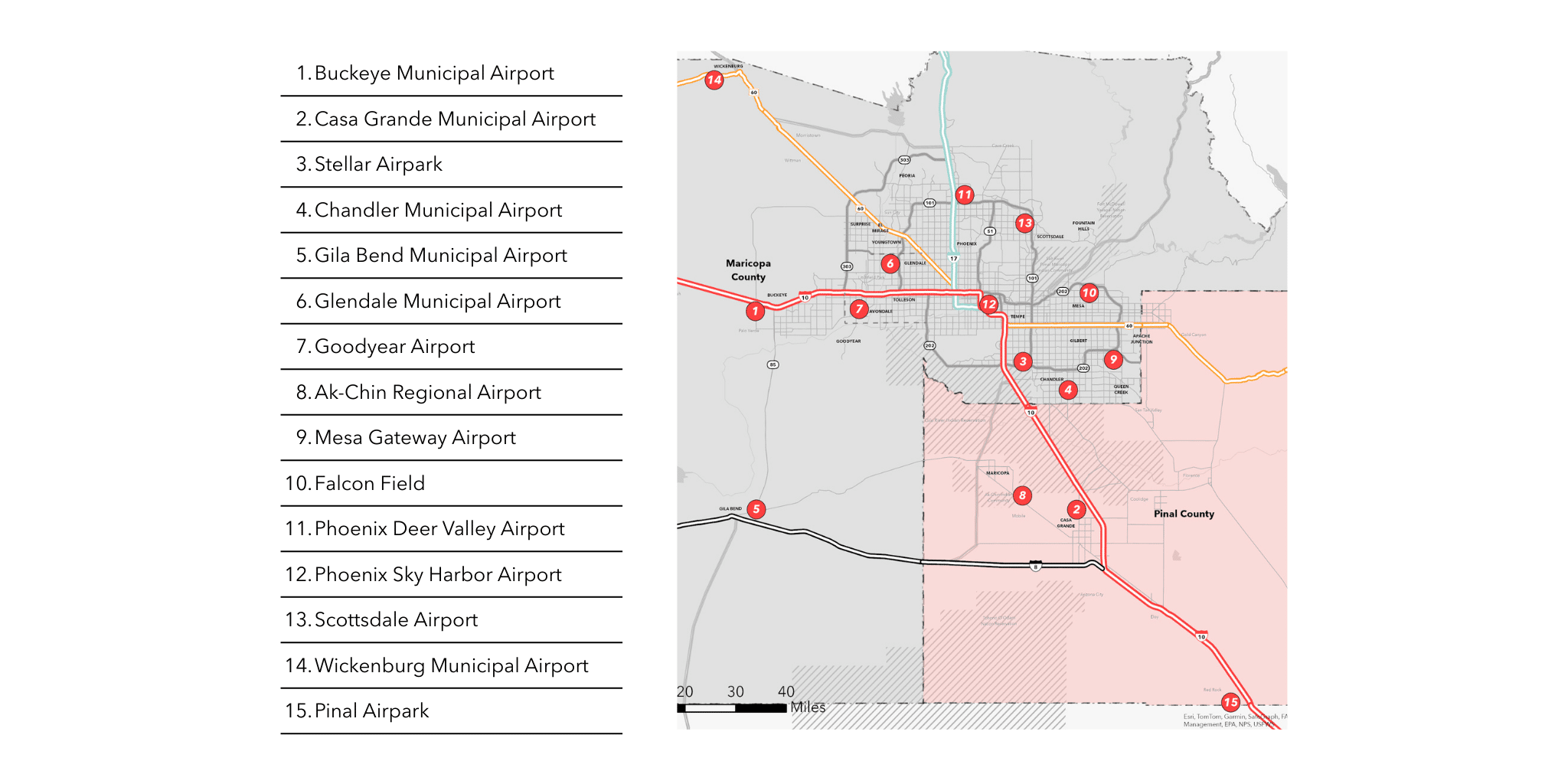
With a population of well over 5 million, Greater Phoenix relies on its network of smaller airports to accommodate growing totals of passengers and cargo moving through the region while also supporting various specialized aviation services. The largest of these is Mesa Gateway Airport, where carriers like Allegiant Air and Sun Country Airlines operate flights to more than 45 destinations. About 2 million passengers are expected to travel through the airport in 2025, and Mesa Gateway contributes $1.8 billion annually to the Arizona economy.
Mesa Gateway is designated as a Foreign Trade Zone and Military Reuse Zone, meaning companies that locate their operations nearby may have access to special tax incentives unavailable at other locations. The adjacent SkyBridge industrial development will be the United States’ first and only inland international air logistics hub with joint U.S.-Mexico Customs processing.
Other flight operations in the region support general aviation, corporate, private, military and cargo activity, including Phoenix Deer Valley Airport, which ranks among the busiest general aviation airports in the nation. Phoenix Deer Valley generates $151.6 million in direct economic impact and $309 million in total economic impact. Phoenix Goodyear Airport serves as a center for aviation education and flight training, with more than 250 resident students on site and generates $369.4 million in total economic impact. Like Mesa Gateway, Phoenix Goodyear is also designated as a Military Reuse Zone.
Across all 15 regional airports and other Arizona airports, the aviation system annually generated $59.4 billion in total economic impact and $3.5 billion in total tax impact in the 2019 study year.
Conclusion
The Greater Phoenix airport system is already an award‑winning, robust, efficient network with a significant economic impact. With boardings projected to continue rising, planning is underway for a new western terminal at Sky Harbor. The dramatic growth of international business activity in the region has created increased demand for international flights, which positively impacts the local economy by driving more tourism and business investments. In 2022, the economic impact from international flights was $3 billion, which does not include the recently added Air France, STARLUX Airlines, and China Airlines flights.
Paired with continued growth across regional airports, the integrated system positions Greater Phoenix to support a growing population, expand trade and strengthen global business ties, ensuring the region remains accessible, resilient and prepared to compete on a global stage.

Download the PDF on International Flight Connectivity.


Industry Expert
Sean Fogarty
Vice President, International Business Development

Industry Expert
Casey Gilchrist
Vice President, International Business Development
1. Source: Arizona State University W.P. Carey School of Business, Economic Impact of the The Phoenix Airport System, June 2024
Published: 1/06/2026