

Ambassador Event: International Flight Connectivity
Published: 01/14/2026
Updated: 04/15/2026
Sky Harbor and Gateway airports are expanding travel and cargo access between global markets and Greater Phoenix
There are a number of ways to evaluate whether a region has become a global metropolis. Business expansion is one — when companies from around the world seek entrance into a market, there’s a sign of high demand. Another is migration patterns. A steady or increasing number of new residents from near and far indicates international prominence. And finally, connectivity. When Phoenix Sky Harbor international flights connect business and leisure travelers to key markets around the world, the region is hitting its stride as a global destination.
Greater Phoenix, with two new direct flights to Taipei through STARLUX Airlines and China Airlines, has achieved all three metrics. Now connected directly to 26 international locations including London, Mexico City, Paris, Taipei and Toronto, Greater Phoenix international connectivity is allowing Greater Phoenix to expand in the international playing field.
The Greater Phoenix Economic Council (GPEC) hosted an Ambassador Event with regional experts adjacent to the release of its new report: International Flight Connectivity. The panelists were:
- Laura Franco French, Director, State Government Relations, TSMC Arizona
- J. Brian O’Neill, Executive Director and CEO, Mesa Gateway Airport Authority
- Alexandria Van Haren, Air Service Development & Marketing Administrator, Phoenix Sky Harbor International Airport
- Christine Mackay, President & CEO, Greater Phoenix Economic Council (Moderator)
“One of the things I love about the relationships with our regional airport system is that it’s not competitive,” Mackay said. “It is truly working together to ensure that the region has great air service.”
Cargo and tourism through Greater Phoenix
With the takeoff of China Airline’s first direct flight from Phoenix to Taipei, Taiwan’s Taoyuan International Airport to Phoenix Sky Harbor on Dec. 3 and STARLUX Airline’s upcoming inaugural flight on Jan. 16, Greater Phoenix has entered a new era of connectivity to Asia.
In 2019, Sky Harbor estimated that 13-25 passengers per day traveled between Phoenix and Taipei. Today, that estimate is in the 140-160 range, and the number will likely increase based on connections for tourists and the semiconductor industry traveling to other locations in east and southeast Asia with strong ecosystems such as Vietnam and the Philippines.
“These flights are going to be invaluable,” Franco French said. “We have over 3,000 employees right now (at TSMC Arizona), so the opportunity to be able to go back and forth to Taiwan to train … it’s incredible for us.”
In addition to this new direct international route from Sky Harbor, Air France currently services three weekly flights from Phoenix to Paris, and plans to increase that to five per week in May and daily in June.
“That’s a testament to the demand that’s in the Greater Phoenix market, is the fact that they are willing to make that investment,” Van Haren said.
These additional flights aren’t just a boon for business travelers and vacationers. Companies benefit from cargo transportation capabilities, such as semiconductor firms and their suppliers shipping goods to Taiwan. Foreign direct investment in Greater Phoenix, Arizona has created strong demand for these routes, as some companies do not have local or regional suppliers, and there are elements of the supply chain, like advanced packaging, that are not yet available in the United States.
“We have to fly (the wafers) back and forth. As you can imagine, those wafers are very sensitive,” Franco French said. “Having the flights rather than having to rely on ocean cargo is just amazing for us.”
Gateway’s close ties with DSV, which announced a regional headquarters in Mesa near the airport, has driven additional business connections with Asia. Prior to DSV’s announcement, Gateway handled about 1 million pounds of cargo annually. Today, Mesa Gateway Airport cargo aircrafts from China and Japan serve chip and medical device manufacturers, helping connect two growing industries to other world markets.
“(DSV is) masterful at making the connection between companies that need to bring products into Arizona and the airlines capable of bringing them,” O’Neill said. “We’ve gone to almost weekly service from Asia on a wide-body into Mesa.”
Expanding the west terminal at Sky Harbor
Sky Harbor continues to advance its infrastructure to keep up with the growing number of passengers from a broadening range of destinations.
The modernization project on Terminal 3 was completed in 2020, adding a new concourse and upgrading the nearly 40-year-old terminal to help travelers navigate more efficiently. Terminal 2 was demolished that same year, as it was unable to accommodate modern air traffic. In 2022, Terminal 4 added a new, 275,000 square-foot concourse and a number of amenities, as well as a remodeled federal inspection services (FIS) facility.
Now, the airport is in the process of building a new terminal on its west side.
Van Haren said the airport plans to build a large, state-of-the-art FIS facility in the new terminal to help accommodate the increasing number of international travelers.
“Our international growth has been greater than we expected,” she said.
Currently, the terminal is in the exploration and environmental impact study phases, Van Haren said. Airport officials told the Arizona Republic in December that the environmental impact study is going faster than expected thanks to the comprehensive statement submitted in 2006, which could allow the terminal to open three years ahead of schedule, as early as 2033.
This will help leisure and business travelers alike, as well as cargo shipments.
“In order to keep up with the global demands of the industry,” Franco French said, “we have to be connected to all of our customers and all of the opportunities.”
Gateway’s service of secondary markets
While cargo is a key priority for Gateway, O’Neill said the airport will look at leisure travel through secondary and tertiary markets and renewing relationships with Canadian airlines that have dropped the Gateway service since the COVID-19 pandemic.
This is where the partnership with Sky Harbor is most evident. Thirty-six of Gateway’s 48 destinations do not have nonstop competition from its neighbor in Phoenix, allowing the regional airport to fill a niche in the marketplace.
Among key routes is Provo, Utah, a destination that Allegiant services 19 flights per week in the summer. Allegiant will be adding three routes this February out of Gateway: Orange County, Calif., La Crosse, Wis. and Bloomington, Ill. O’Neill said he was curious about the traffic patterns between La Crosse and Arizona, but following the announcement, people would approach him in public to excitedly share they moved here from La Crosse or have family there.
“I’m always surprised at how these smaller, kind of overlooked markets perform really, really well,” O’Neill said. “Allegiant has this knack of finding these markets that are underserved and that there is some reason for them to come here or for us to go there.”
The large population of Mesa, more than 500,000 people, coupled with the economy of Greater Phoenix increasing in global notoriety, has propelled growth of Gateway Airport. Over the last five years, there has been more than 1.6 million square feet in development immediately surrounding the airport, including DSV, Virgin, Gulfstream and XNRGY.
“This type of growth is not happening at many other places across the country,” O’Neill said. “You need to continue to work with and educate (airlines) and convince them that starting at a secondary airport that’s only 28 miles from a huge airline hub is going to be their next best business decision.”
Meet the panel

Laura Franco French
Director, State Government Relations
TSMC Arizona

J. Brian O’Neill
Executive Director and CEO
Mesa Gateway Airport Authority

Alexandria Van Haren
Air Service Development & Marketing Administrator
Phoenix Sky Harbor International Airport
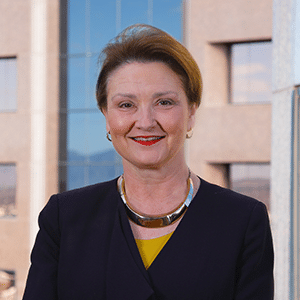
Christine Mackay (Moderator)
President & CEO
Greater Phoenix Economic Council