Arizona Water: A history of conservation
Published: 07/17/2026
Updated: 08/14/2026
Arizona leadership has built water infrastructure suitable for desert living since before statehood
Over a thousand years ago, the Hohokam people developed more than 500 miles of canals as large as 12 feet deep by 13 feet wide. Over 150 years ago, the Salt River Valley Canal was constructed. In 1911, construction of the Roosevelt Dam was completed. And one year later, Arizona became a state.
Arizona’s history of water stewardship goes well beyond its statehood, and our appreciation for water security has not been lost to the years.
Water is indispensable to livelihoods of Arizona and Greater Phoenix, and the state has furthered its water portfolio throughout the 20th and 21st centuries. By adding canals to direct Colorado River water through the state, establishing legal and physical framework to assure a 100-year groundwater supply, and constructing water storage systems, state leadership has ensured water reliability even during the 25-year drought affecting the southwest today.
“Drought is a weather condition that we don't have any control over. A shortage is what happens if you haven't properly planned,” said Salt River Project (SRP) Senior Director of Water Supply and System Christa McJunkin. “If we make the right investments in water resources and water infrastructure, we can withstand a drought.”
Does Arizona have water?
Yes! Thanks to comprehensive management techniques, modern forms of conservation and water reclamation, and the broader economic shift as farmland has urbanized, Arizona uses about the same amount of water today as it did in the 1950s, despite massive population and economic growth.
What is the breakdown of Arizona’s water portfolio today?
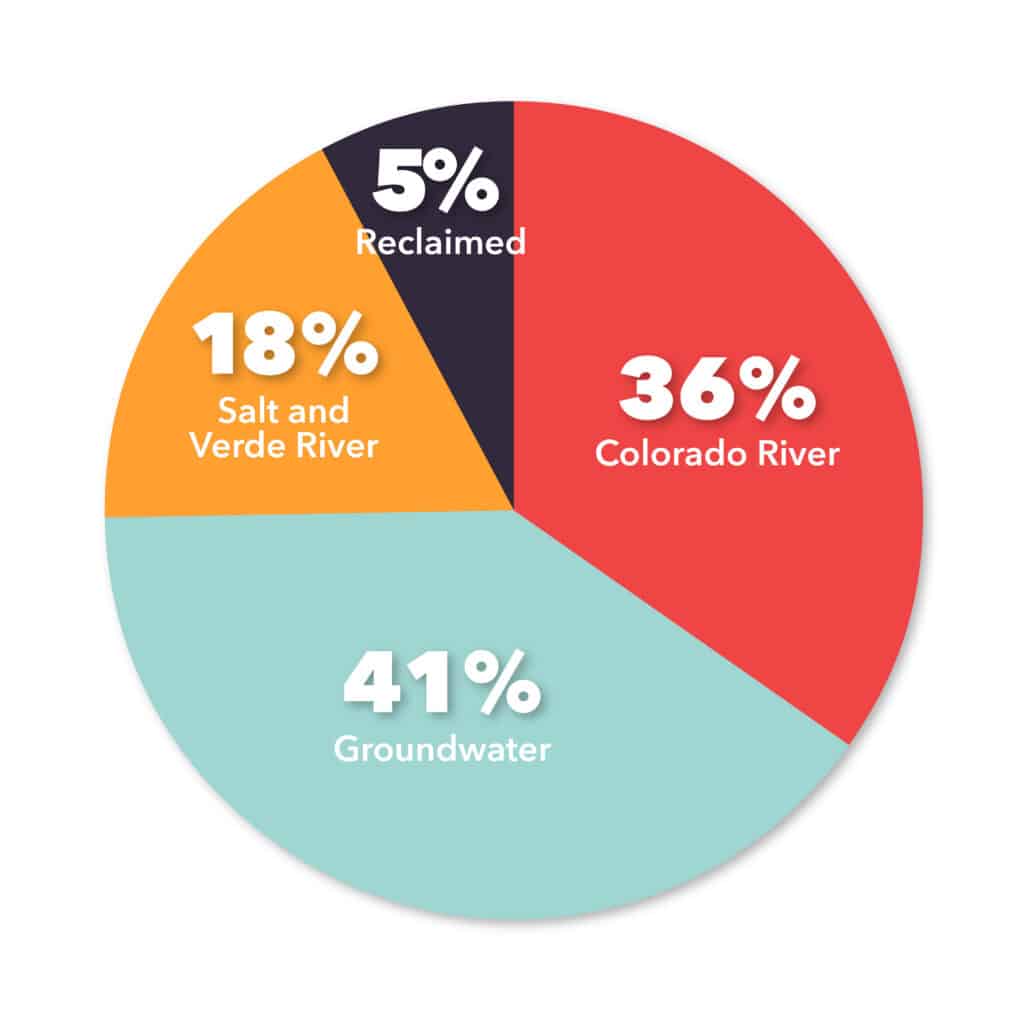
Today, Arizona has four primary water sources: the Colorado River, groundwater, the Salt and Verde Rivers, and reclaimed water. Groundwater makes up the largest portion of use in both Arizona and Greater Phoenix, approximately 41% throughout the state and 34% in Greater Phoenix. The Colorado River is about 36% of statewide water usage and 29% of Greater Phoenix’s.
Who are the primary water providers?
SRP and Central Arizona Project (CAP) are two of the largest water providers in Arizona.
Formed in 1903, SRP delivers more than 325 billion gallons of water annually through management of its seven large reservoirs and two underground water storage facilities. Its water management extends through the Salt and Verde watersheds, which originate in northern Arizona. The CAP canal, authorized in 1968 and completed in 1993, is a 336-mile canal system that carries Colorado River water to central and southern Arizona.
In 2025, these providers announced a plan to connect their systems to allow for increased flexibility of water movement. This means that in a time of Colorado River shortage, SRP would be able to move water into the CAP system, or in a wet season like 2023, when SRP had to release excess water from its reservoirs, it would be able to move the water into CAP’s underground storage facilities.
What are some specific examples of successful Arizona water management?
The 1980 Groundwater Management Act established the framework to assure a 100-year water supply in Active Management Areas (AMAs). In doing so, new subdivisions must demonstrate having a sufficient quantity and quality of water to sustain the proposed development for at least 100 years. This has allowed the influx of homes and businesses to be assured of adequate access to water and that water supplies are not overdrawn.
Arizona has developed a variety of underground storage programs to manage unused supply. Among those programs and projects are the Arizona Water Banking Authority (AWBA), which was formed in 1996; recharge facilities New River-Agua Fria Underground Storage Project (NAUSP) and the Granite Reef Underground Storage Project (GRUSP), developed and managed by SRP; long-term credit programs to help firm and manage water while there is a shortage; and underground water used to replenish aquifers with renewable supplies.

The expansion of the Roosevelt Dam in 1996 added 77 additional feet of height and new spillways to the dam, allowing for the collection and retention of additional water.
“That reservoir allows us to manage the water supply, taking a water supply that can go through very dry periods and very wet periods, and make it dependable year over year,” McJunkin said.
These are just a few of the many examples of water stewardship in Arizona’s history.
How is Arizona developing new water storage and conservation techniques?
There are a variety of organizations in Arizona working toward new water management activity. SRP is evaluating options to raise and expand Bartlett Dam to retain more water, as well as sedimentation management along the Verde River.
“SRP is exploring ways to increase water storage capacity along the Verde River at Bartlett Reservoir to increase local water supplies for generations to come,” McJunkin said. “We are considering options like desalination programs with users in neighboring states, which could help Arizona offset Colorado River shortages.”
The Water Infrastructure Finance Authority of Arizona (WIFA) was established as a state agency in 2022 to invest in projects augmenting Arizona’s long-term water supplies and assisting public water treatment projects. Governor Katie Hobbs announced $60.3 million in funding toward WIFA in 2025 for activities including the establishment of a Water Conservation Grant Fund, improvements to technical and infrastructure for disadvantaged water systems, combatting of PFAS, expansion of renewable water infrastructure in the city of Buckeye, monitoring of groundwater, and more.
Arizona State University (ASU) received $40 million in state funding to lead a multi-year initiative to develop new approaches and technology for water conservation, augmentation, desalination, efficiency infrastructure and reuse with partners around the state including industrial, municipal, agricultural, tribal and international.
“I'm very optimistic because I know that our predecessors have done a fantastic job in planning for the future,” said city of Phoenix Water Resources Management Advisor Dr. Max Wilson. “And I think our current leadership is doing the same thing.”
What is on the horizon of our water future?
SRP has discussed long-term desalination programs and exchange agreements with water users in other states. In the shorter term, to have additional water supplies and greater control over its resources, Arizona users are developing plans for advanced water purification (AWP) facilities.
“Advanced purified water is the cleanest water that we can produce today,” Wilson said. “It is as clean or cleaner than any of the water currently coming through your tap that you use today.”
Communities around the country and world reuse water. Traditional wastewater is discharged back into rivers or streams, then treated to be potable and reused. AWP goes a step further, using treatments including reverse osmosis filtration and advanced oxidation to purify water without the additional step of sending it back into a body of water. The Cave Creek Advanced Water Purification Facility, under construction in north Phoenix, will produce 7 million gallons of purified drinking water daily once construction is complete.
“What advanced water purification allows us to do is to take the next step in water conservation, where Arizona has always led at its core,” Wilson said.

Find up-to-date information about Arizona water on GPEC's social media channels and with #AZWaterFacts.