
Ambassador Event: European Insights
Published: 05/19/2026
Updated: 05/18/2026
European investment has increased in Greater Phoenix as advanced industrial strengths have aligned
Greater Phoenix’s emergence as a top market for international business has been driven in part by the coordination with European countries, trade groups and businesses over the past decade.
Since 2015, there have been 142 expansions of European companies into Maricopa and Pinal counties, a new report from the Greater Phoenix Economic Council (GPEC) shows. These projects, consisting of 111 individual companies, have resulted in more than $8.1 billion in investment and created about 15,000 jobs in the region.
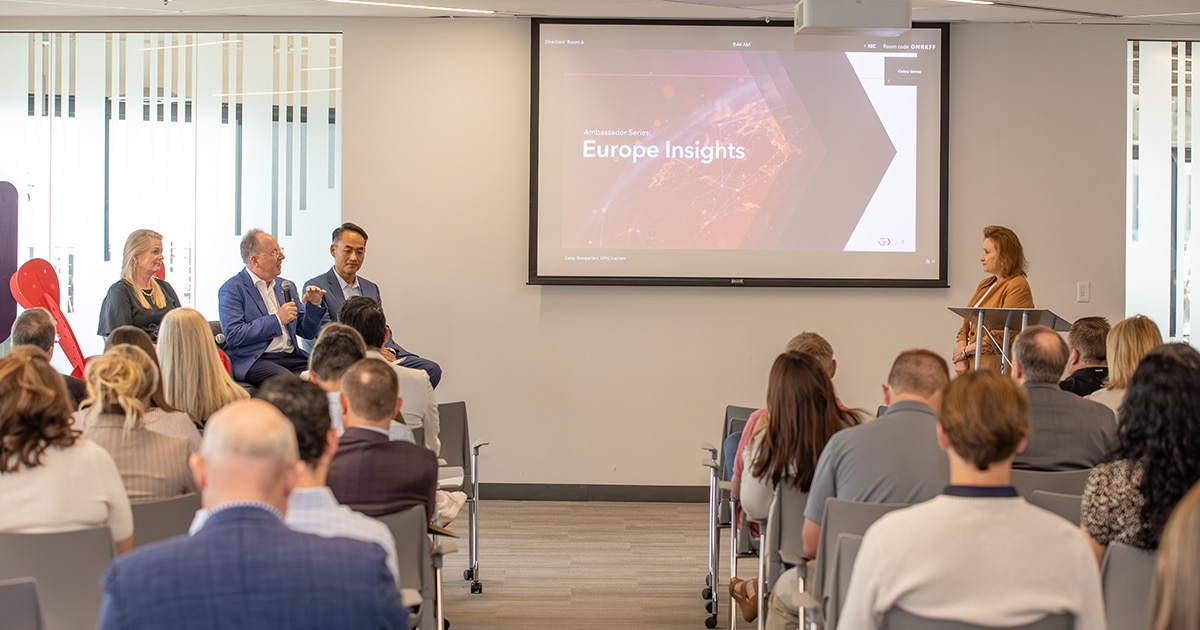
GPEC released this report during an Ambassador Event with a panel of local experts to explore the relationship between Greater Phoenix and Europe. The panelists were:
- Odette Bakker, Head Government Relations and Community Affairs USA, ASM
- David Kim, Vice Chair, U.S. Management Team; Head of Legal and Compliance, U.S., ASML
- Andre Kudelski, Chairman and CEO, Kudelski Group
- Christine Mackay, President & CEO, Greater Phoenix Economic Council (Moderator)
The realization of the advanced manufacturing hub in Greater Phoenix has created new opportunities for companies from European countries to enter the market, but some of these companies were early leaders of the region’s technology ecosystem. ASM, ASML and Kudelski Group have long called Arizona home, breaking up the typical concentration of East Coast-heavy expansion activity.
“The East Coast has been influenced too much in a way by Europe over the centuries, and Arizona is a little more independent from this way of thinking,” Kudelski said. “That is why things impossible that are impossible in other places are possible here.”
Building the European connection
Kudelski first entered Arizona in 1978, when the company, managed by his father, had a relationship with Motorola, a godfather of the Greater Phoenix chip industry. “If you just visited here, you saw there was something magical,” he said.
Similarly, ASM has been in Arizona since the 1970s. The company expanded to Greater Phoenix in large part due to Motorola, the first client of ASM. Bakker said the company chose the Greater Phoenix expansion rather than California due to Motorola and the talent pool.
ASML was drawn to Arizona in part due to ASM, its former parent company, and Intel, which has operated in Arizona since 1979. Kim said Arizona’s welcoming, and “predictable” environment with minimal obstacles has helped the company continue its growth.
“The competition is global and we have choices,” Kim said. “The partnership collaboration and enablement from the community is very, very important.”
Yet it took time before the region blossomed as a primary destination for European investment. While Greater Phoenix had strength in semiconductors and aerospace & defense (A&D), the economy was not centered around the myriad of high-tech fields aligned with key European markets until the end of the Great Recession, a time in which Arizona and regional leaders strategized a resilient economy built off advanced technology and medical manufacturing.
Greater Phoenix institutions have collaborated to develop key components of a manufacturing hub ranging from workforce development to economic development programs and infrastructure modernization.
“If you go to SelectUSA and see how other states present themselves, the collaborative efforts of GPEC, ACA, cities and universities have made a world of difference,” Bakker said.
As the market developed its operating environment, European companies have noticed: from 2015-25, 130 European companies expanded in Arizona, investing nearly $10.8 billion and creating almost 17,000 jobs. Europe has emerged “as a cornerstone partner” in A&D, biosciences and medical device manufacturing, cybersecurity, semiconductor development and more high-value supply chains, Mackay said.
Over the years, Kudelski has visited other leading markets in the U.S. to evaluate expansion opportunities.
“Rather than follow the other (companies), we have tried to look at what we really need,” Kudelski said. “(We came) to the conclusion that if we look not at the past, but the potential for the future, Arizona is really the right place to be.”
The next level of growth in European FDI
While the big-picture look at Europe is necessary to evaluate the growth of Arizona’s global trade, each country has a unique operating environment, with different strengths and weaknesses in industry.
“Every country has their own foreign direct investment strategy, their own tools to scale up,” Bakker said, explaining that a trade office or agency in one country will likely not have an impact on relationships with a neighboring member of the European Union. “Every country wants to attract the best companies… Their vested interest is with their own economy.”
Targeting countries based on their individual strengths has helped local economic developers build relationships with companies and trade offices from Europe. On a trip with the U.S. Commercial Service and SelectUSA to several countries in the continent, GPEC found opportunities with France for industry-specific associations, while the Netherlands had more interest in soft-landing opportunities like the Arizona International Soft Landing Experience (AISLE). Relationships with both have grown through connections with groups like the French-American Chamber of Commerce and the Netherlands Business Support Office, both of which have operations in Greater Phoenix.
Bakker, the Honorary Consul of the Netherlands in Arizona, said there are immense opportunities in countries with knowledge-based economies like the Netherlands, Switzerland, Sweden and Luxembourg, places that “have products but lack market.”
Companies from the Netherlands like ASM, ASML and NXP have helped build Arizona’s semiconductor environment. Kudelski, a cybersecurity company from Switzerland, represents an industry strength of the European nation.
“To be able to be a European champion in new technology is not so obvious,” Kudelski said. "Fundamentally, the U.S. is one of the most natural markets for companies from these countries. We need to look at specific needs for companies from different countries.”
Among next steps is further work to connect more direct flights to markets like the Netherlands and Switzerland. Phoenix Sky Harbor International Airport has direct connections to London and Paris, but additional services would help ease the burden of the business community deciding between a long-standing East Coast hub or newer West Coast destinations.
Workforce development through industry-university partnerships
Similarly, the necessary workforce varies not only from country to country but state to state. ASM, ASML and Kudelski all have partnerships with local institutions like Arizona State University (ASU), University of Arizona (U of A) and Grand Canyon University to develop talent locally.
“One of the best-kept secrets of Arizona is ASU,” Kudelski said. “Most universities in the U.S. define themselves by the people that they are not taking. ASU is explaining who we are including.”
As part of a memorandum of understanding between the Netherlands and Arizona for cooperative semiconductor development, ASM and ASML are developing a partnership with ASU and U of A for educational summer programming.
Additionally, ASML operates a training center in downtown Phoenix for professionals and customers to learn to optimize ASML systems.
ASU and GCU are taking part in an apprenticeship program alongside Kudelski. Over 20% of Swiss population has gone through a local apprenticeship program, Kudelski said, opportunities often overlooked in the United States. Partnerships with local universities include an opportunity for students to do two years of an apprenticeship while at community college, and then decide whether to work or attend a university.
Kudelski found similar solutions with ASU and GCU through programming and an exchange program with Spain and Switzerland, creating unique training opportunities that build upon the Greater Phoenix talent pipeline via industry partnerships.
“We have students and apprentices that can go through these courses, get much better training than they would have,” Kudelski said.
Meet the panel
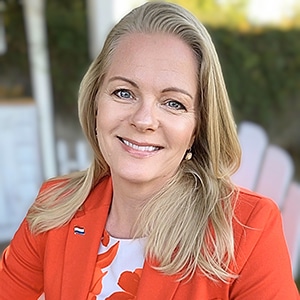
Odette Bakker
Head Government Relations and Community Affairs USA
ASM
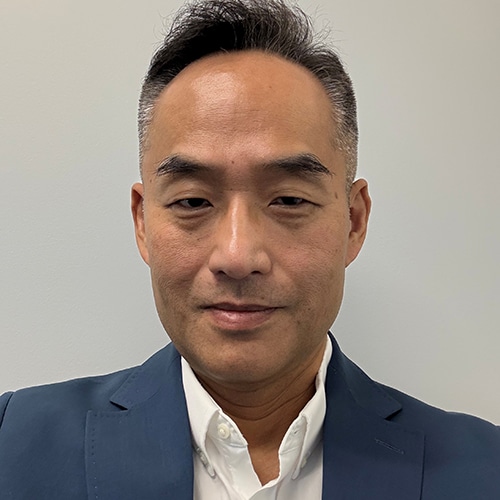
David Kim
Vice Chair, U.S. Management Team; Head of Legal and Compliance, U.S.
ASML
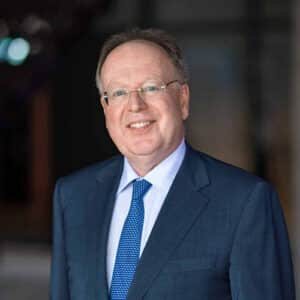
Andre Kudelski
Chairman and CEO
Kudelski Group
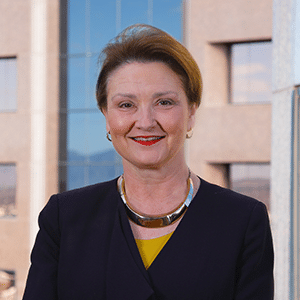
Christine Mackay (Moderator)
President & CEO
GPEC