

Ambassador Event: State of the Region with the Federal Reserve Bank of San Francisco
Published: 06/10/2026
Federal Reserve EVP Sylvain Leduc discussed how the fed balances inflation and employment across economic uncertainty
Approaching the midway point of 2026, the national economy is feeling the impacts of a variety of sources: Some, like developments in AI and advanced technologies, have added optimism to continued growth and investment. Others, like oil price increases triggered by the conflict in Iran, have raised inflation and uncertainty.
On June 2, Greater Phoenix Economic Council (GPEC) hosted Sylvain Leduc, the Executive Vice President and Director of Research with the Federal Reserve Bank of San Francisco, to speak at a GPEC Ambassador Event for partners of the economic development organization. He was joined by GPEC President & CEO Christine Mackay, who moderated the discussion.
Much of the conversation revolved around the two basic mandates of the federal reserve: price stability and maximum employment.
Price Stability: Inflation in the United States
The ideal inflation rate is 2%. Leduc explained that this is a "pragmatic" mark, as there is economic growth and investment — the economy isn’t at risk of stagnation or deflation — but consumer costs don’t rise at a rate that affects day-to-day decision making.
The U.S. struggled to maintain that 2% figure coming out of the Great Recession and into 2020, causing fed concerns that it was too low. The COVID-19 pandemic flipped that; a variety of factors including supply chain disruption and government spending made the rate skyrocket. It peaked at 7% in 2022.
Inflation crossed back below 3% in 2023 and remained in the 2-3% range for over two years. In 2025, the increase in cost of core goods caused inflation to begin to rise again, driven largely by products impacted by tariffs. In 2026, energy costs — specifically gasoline following the beginning of conflict in Iran — caused it to cross the 3% line, reaching 3.8% in April and 4.2% in May.
Despite the jump, there are reasons for optimism, Leduc explained. One such is that the increase of prices has not spilled over into the service sector, which tend to decrease slower than that of goods. About 80% of U.S. jobs are in the service sector, he said, allowing for more economic stability. Secondarily, the price increases related to tariffs and oil are happening where it is “intuitive,” Leduc said.
“To the extent that these are one-offs … you would think that once they disappear, (inflation) will be back down to a much lower level,” he said. “We’re seeing inflation at the right place, where we think it’s intuitive to see it.”
Maximum Employment: Balancing inflation and employment
Since the country recovered its job losses from the pandemic, unemployment has been in strong shape, generally around 4%. The number has trickled up slightly since 2022, at which time the fed raised rates to slow inflation, but it remains healthy.
This level of employment has helped the economy remain lively.
“Part of why the consumption growth rate has been so sustained is because the labor market is doing fairly well,” Leduc said.
Maximizing employment doesn’t mean getting unemployment to 0%. For hiring, job transitions, and business and industry expansion, a market needs some jobseekers.
“Maximum employment is defined as the highest level of employment we can achieve overtime, sustainably, in the context of price stability,” Leduc said. “We can’t target super high employment if it comes at the cost of generating inflation.”
The balance is difficult. To combat increased inflation, the fed typically raises rates in effort to reduce spending and slow economic activity. This can lead to increases in unemployment, but the most direct way to promote hiring is to decrease rates — thus increasing inflation.
“Policymakers are kind of in a bind,” Leduc said. “The fed, in these occasions, tries to follow a balanced approach.”
What is supporting growth in the U.S. and Greater Phoenix?
Despite the general uncertainty, investment within the United States economy has held strong, and Greater Phoenix is expected to continue seeing modest gains in the coming year.
A handful of industries are at the center of this. AI has driven investment in semiconductor chips, computers and data centers, with Leduc citing about 23% year-over-year growth in investment that rivals that of the 1990s.
“People are putting money behind the enthusiasm,” he said.
Healthcare has seen substantial employment growth in recent years, and manufacturing employment has held stable. This is reflected in Greater Phoenix, which has intensified focus on industries like these over the last decade-and-a-half.
“Since the Great Recession, we have driven an economy focused on manufacturing, healthcare, and aerospace and defense,” Mackay said. This has helped Greater Phoenix remain resilient, securing a foundation in semiconductor production and medical innovation that has allowed the region to withstand global shocks.
Meet the Panel

Sylvain Leduc
Executive Vice President and Director of Research
Federal Reserve Bank of San Francisco
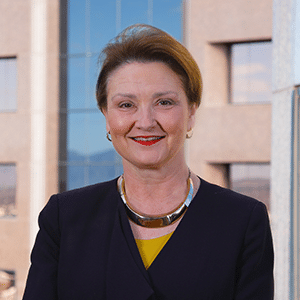
Christine Mackay
President & CEO
Greater Phoenix Economic Council (GPEC)